
· by Michael Blair, Nashville's Shutters and Blinds
Arched tops, angled gable windows, transoms above doors and windows meeting at a corner are where the standard catalog stops helping. Each has a normal solution, and the first question we ask is whether the covering needs to move.
Decide whether it has to operate
Most odd-shaped windows sit high and out of reach, and they are there to let light in rather than to be looked through. A fixed treatment has nothing to tilt, lift or wear out, and on an arch it is a much simpler thing to build than a covering made to travel through a curve.
Berkeley Lab’s research on residential window attachments notes that most window coverings are used to control glare, give privacy or simply for looks, and that is a fair test for an awkward window too. Glare that lands on a screen or a favorite chair at one time of day justifies something that operates, and so does a bedroom that needs to be properly dark, which our post on blacking out a bedroom deals with. A decorative transom over a front door almost never does.
What goes on each odd-shaped window?
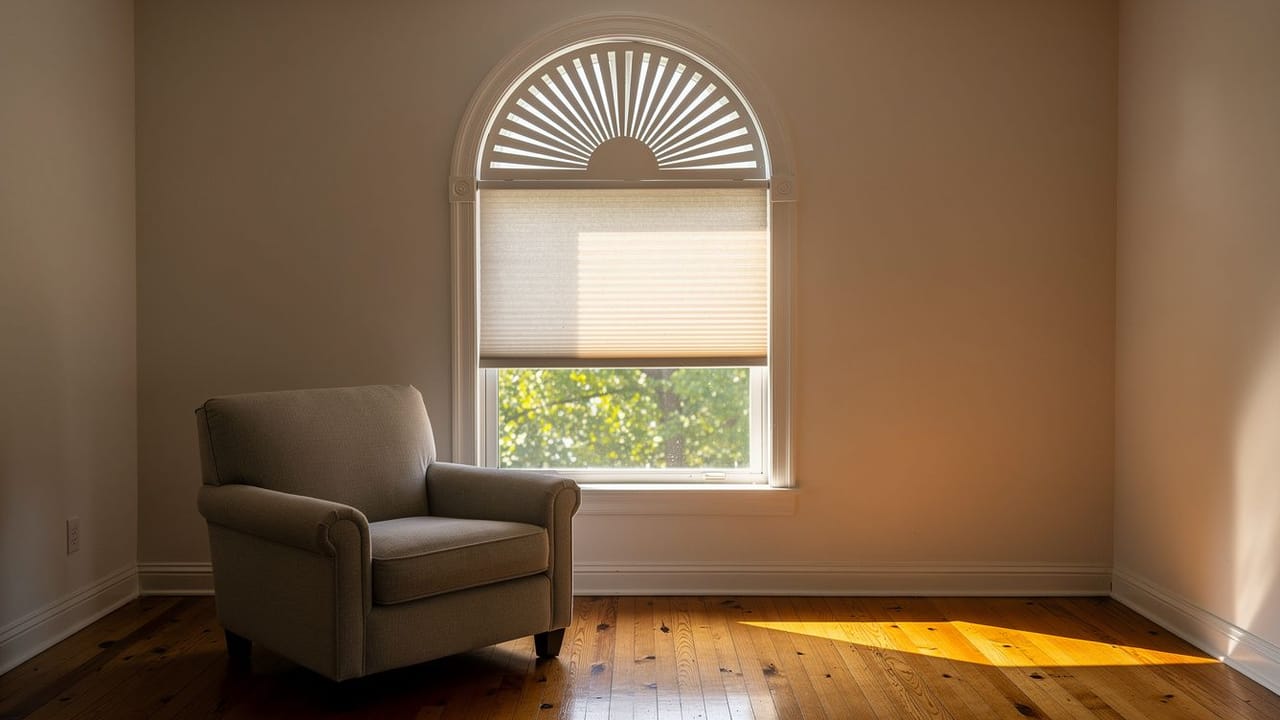
A true arch usually gets a fixed arched shutter panel, and shutter makers build for the shape: Hunter Douglas lists its interior shutters as available for specialty shaped windows, arches among them. Our plantation shutters are built to the opening, which counts for more on a curve than anywhere else. An arch over a rectangular window we usually treat as two pieces, with a fixed arch above and an operable blind or shade below.
For an angled top in a gable, we look first at a fixed shutter cut to the slope. Transoms above doors take a fixed panel or a small shade. Corner windows we handle as two separate windows whose treatments meet at the corner, since nothing sensible bends around it.
- True arch: fixed arched shutter panel
- Arch over a window: fixed above, operable below
- Angled gable: shutter cut to the slope of the top
- Transom: fixed panel or small shade, rarely worth operating
- Corner: two treatments meeting, not one continuous unit
Why does an arched window need a template?
A curve can’t be pinned down with a width and a height. We make a template against the actual opening before anything is ordered, because the arch in an older house may not be a true arc and the opening may not be square to itself. The same problem on an ordinary rectangular window is covered in our post on shutters for out-of-square openings.
A custom shape is made for one opening, so it usually can’t be returned or used anywhere else, and the supplier’s return policy is worth reading before the order goes in. That is also why we won’t quote a custom arch from numbers read over the phone. If you have an arch, a gable or a corner window to cover, ask us for a free estimate.
The Middle Tennessee heat argument
In any climate, sunlight coming through a window can add heat you don’t want, as the National Fenestration Rating Council’s guide to window comfort puts it, and Berkeley Lab warns that this solar heat gain can threaten comfort and safety during a heatwave. A tall arched or gable window facing west takes the full afternoon sun of a Middle Tennessee summer, and if that room feels noticeably warmer late in the day, the window is the first place to look.
That makes covering a high window a comfort and energy decision as well as a decorative one, and it changes what to choose. Berkeley Lab found the results depend on climate: in cooling-dominated climates every attachment it modeled saved energy, while where heating outweighs cooling, a mix of insulation and balanced solar control did best. Among the shades in its cold-climate example, cellular shades used the least energy at three of the four performance levels it tested.
To stop heat before it gets inside, the lab’s guidance on extreme heat points to permanent fixes such as shades, preferably on the outside, or specialized windows or films. NFRC adds that windows with low-e coatings block more outside heat without spoiling the view or the daylight. The rest of the house is covered in our post on window treatments that cut Nashville heat.
Sources
- Lawrence Berkeley National Laboratory, Residential Windows and Attachments — Coverings used for glare, privacy and looks; solar heat gain threatens comfort and safety in heatwaves; results depend on climate; cellular shades lowest energy use among shades in the cold-climate example except quality D; exterior shades, specialized windows or films as permanent fixes
- National Fenestration Rating Council, Control Comfort (Efficient Windows Collaborative) — Sunlight through windows adds unwanted heat in any climate; low-e coatings block more external heat without losing view or daylight
- Hunter Douglas, Shutters — Interior shutters available for specialty shaped windows such as arches
FAQ
Covering Arched and Odd-Shaped Windows — questions
Do arched windows need to be covered at all?
Often not. A high decorative arch letting daylight into a room that is not overlooked and has no glare problem is doing its job, and covering it costs money and loses the light. The usual reasons to cover one are afternoon heat on a west exposure, glare onto a screen, and a bedroom that needs to be dark.
Can blinds be made to fit an arch that opens?
It depends on the product, so ask the supplier what it makes for a moving arch. For the curve itself we usually recommend a fixed treatment, since it has no mechanism to adjust or wear. Where the arch sits over a rectangular window, the practical answer is a fixed arch above and a normal operating shade or blind below, which gives you control of the part of the window you actually look through.
How are angled gable windows measured?
We work from a template as well as a tape, because both the angle and the squareness of the opening matter. Getting it wrong is expensive, since a custom shape is made for that one opening and usually cannot be returned, so ask any supplier for its return policy before you order.
How do you cover an arched window?
Usually with a fixed arched shutter panel built from a template of the actual opening, since an old arch may not be a true arc. Where the arch sits over a rectangular window, we put a fixed piece in the curve and an operable blind or shade below it, so the part you look through still opens and closes.