
· by Michael Blair, Nashville's Shutters and Blinds
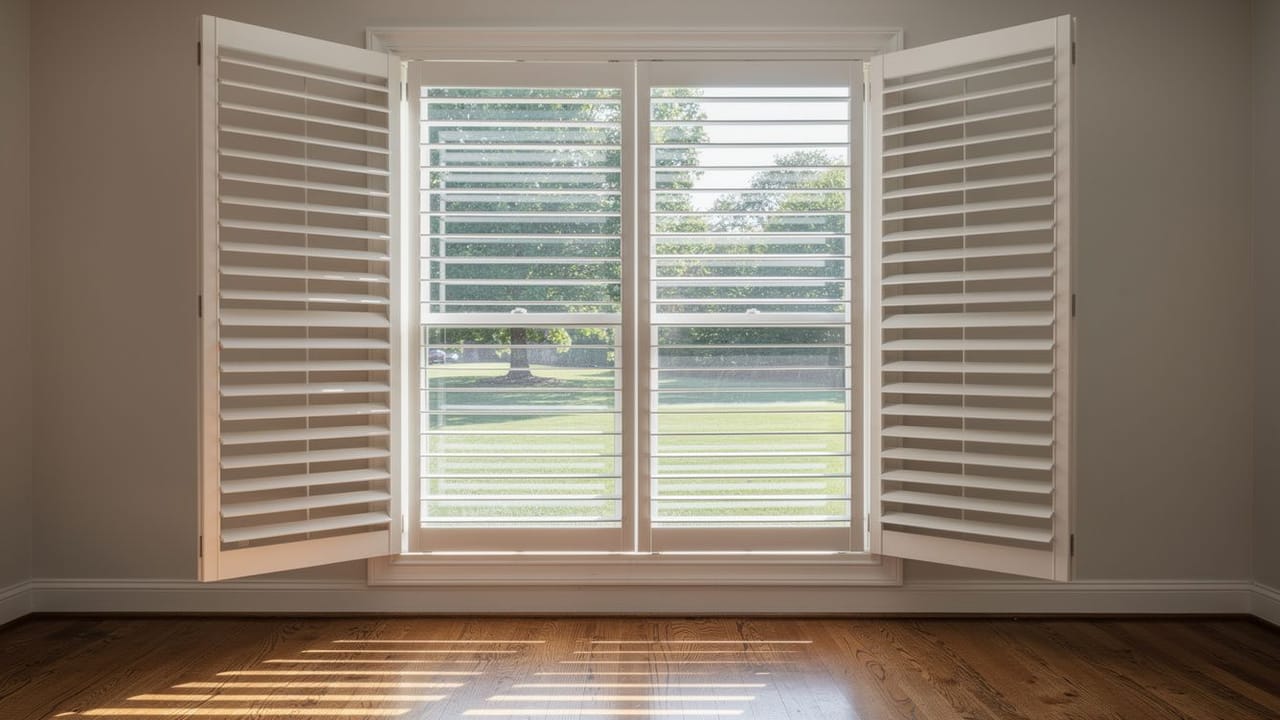
Once a household has settled on plantation shutters, the questions change. Whether they are worth it is the subject of are plantation shutters worth the cost; what is left is the order itself: how wide the louvers are, which frame goes around the window, whether it sits inside the opening or on the wall, what each panel is made of, and where a rail crosses a tall panel. Every one of those is decided once, because shutters are built to a single opening and do not adjust afterward. This is the order we take them in when we measure a house in Franklin, Brentwood or elsewhere in Williamson County, and the same choices sit behind every set on our plantation shutters page.
Louver size and what it does to the view
The louver is the slat, and its width sets both how the shutter looks and what you see through it when it stands open. Hunter Douglas offers three widths on its Palm Beach vinyl shutters, 2 1/2, 3 1/2 and 4 1/2 inches, according to the Palm Beach reference guide, and the same three on its NewStyle composite shutters. Norman adds a 3-inch louver to those on its AquaShield line. Sunburst names the range plainly on its Polywood page: 4.5 for the most view, 3.5 as the traditional size, 2.5 as the colonial look.
A wider louver means fewer of them in a panel, so fewer edges cross the glass when they are open and more of the yard shows between them. Closed, a wide louver shuts the light out just as well, but it reaches further back toward the glass as it turns, which is why the frame has to leave it room. Narrow louvers suit small windows and traditional rooms, where a wide louver would leave two or three slats in a short panel and look heavy. On a tall window facing the back lawn the widest size is usually right; on a small bath or stair window the narrow one sits better.
The tilt control changes the view too. A traditional shutter has a rod down the face of each panel that moves the louvers together. A hidden tilt moves that linkage to the back edge, so the front of the panel is clean and you tilt it by moving any louver. We fit hidden tilt where the view is the point of the window, and keep the front rod where the household wants the classic look.
Frames, mounts and the depth a window has to give
The frame is the part fastened to the window, and the panels hang from it. The two families are named for their profile, L and Z. In the same Hunter Douglas guide, the extended casing L-frame can go inside or outside the opening and needs a flush inside mounting depth of 2 7/16 inches plus louver clearance, while the decorative Z-frame mounts inside and needs 1 1/4 inches plus louver clearance. Norman lists fourteen frames for AquaShield, among them beaded and bullnose Z-frames and colonial and plain L-frames. The Z sits in the opening with a lip that covers the gap at the jamb; the L reads more like a thin piece of trim.
Inside mount puts the frame within the window opening and outside mount puts it on the wall or casing around it, the same principle our inside or outside mount post explains for blinds. Shutters add a depth test of their own: the louvers swing back toward the glass as they open, and the Palm Beach guide tells the installer to check the clearance between the back of an open louver and the glass, the mullions, any cranks and any handles. A casement crank or a sash lock that stands proud of the window is what a louver usually hits.
When an opening is too shallow for the frame and the louver swing together, there are three ways out: a narrower louver, a frame that builds out from the opening, or an outside mount. We settle that at the window with a tape against the jamb, not from a catalog.
Hardwood, composite or vinyl in a humid house
Middle Tennessee summers are humid, and a kitchen, a bath or a laundry room adds its own water on top of that. The materials handle it differently, and the manufacturers say where each belongs. Graber’s guide to interior shutters describes its wood shutters as North American hardwood, basswood, and says to keep them away from water; it says composite stands up to heat and humidity without peeling, warping or cracking, and can take a soaking, which suits it to bathrooms, kitchens and laundry rooms.
Hunter Douglas splits its range the same way on its shutters page: Heritance is natural hardwood, NewStyle is composite, and Palm Beach is a polysatin vinyl it says is designed for intense sunlight and moisture. Norman sells AquaShield as a waterproof shutter for bathrooms, kitchens and other high-humidity spaces, and Sunburst calls its Polywood moisture-resistant.
In practice that sorts most houses into two zones. Living rooms, bedrooms and studies, where the air is conditioned and nothing gets wet, can take hardwood if the household wants real wood or a stained finish. The window beside a tub, the one over a kitchen sink, the laundry room and a room over a crawl space that runs damp go in composite or vinyl. The choice is made window by window, not for the whole house at once.
- Hardwood: dry, conditioned rooms, and the one that takes a stain
- Composite: kitchens, baths and laundry rooms
- Vinyl: wet rooms and windows in hard afternoon sun
- Waterproof lines such as AquaShield: baths and other high-humidity rooms
Divider rails, measuring and the day of installation
A divider rail is the horizontal bar that splits a panel into an upper and a lower bank of louvers, so the bottom can stay closed for privacy while the top lets light in. It is also structural. For its Palm Beach shutters, Hunter Douglas requires one rail on panels over 66 inches tall and two over 96 inches, and on panels over 50 inches tall without a rail it uses tie louvers instead. We set the rail level with the window’s own meeting rail where there is one, so the bar does not cut across the middle of the view.
Because shutters are made to the opening, measuring decides whether they fit; the Graber guide notes that an error of an eighth of an inch can keep a frame from going in. When we measure for shutters in Franklin or in Brentwood, every window is measured on its own: the width at top, middle and bottom, the height at left, center and right, both diagonals to see whether the opening is square, the depth from the face of the trim to the glass, and every crank, lock and handle the louvers must clear. Two windows that look alike are not assumed to be the same size.
Installation is mostly about the frame. It is fastened to the jamb or the wall and shimmed until it is square and plumb, even where the opening is not, and only then are the panels hung on their hinges. The panels are adjusted to meet evenly, the louvers lined up across them, the louver tension set so they hold where they are put, and the seam at the wall or trim caulked and touched up. To go through these choices at your own windows, ask us for a free estimate.
Sources
- Hunter Douglas Architectural, Palm Beach Polysatin Reference Guide (May 2025) — Louver sizes, L- and Z-frame mounting depths, louver clearance check, divider rail and tie louver heights
- Hunter Douglas, NewStyle Composite Shutters — Composite shutter louver sizes
- Hunter Douglas, Shutters — Hardwood, composite and vinyl lines and where vinyl is meant to be used
- Norman, AquaShield Shutters — Waterproof shutters for high-humidity rooms, louver sizes including 3 inches, frame styles
- Graber, A Guide to Different Types of Interior Shutters — Wood versus composite in humidity and water, and how small a measuring error stops a frame fitting
- Sunburst Shutters, Polywood Shutters — What each louver size is for, moisture resistance