
· by Michael Blair, Nashville's Shutters and Blinds
A plantation shutter is built square, with straight stiles, level rails and louvers that line up across every panel. The window it goes into usually is not quite square, and in a Nashville house that has settled for decades it may be well off. Installation is the work of fitting one to the other so the panels open, close and meet as if the opening were perfect. This post walks through how that is done on the plantation shutters we install: how the frame is set and shimmed, how the panels are racked level, how an out-of-square opening is handled, and what the finished job should look like before the installer leaves. The figures quoted come from Hunter Douglas’s documents for its own Palm Beach polysatin shutter; other makers publish their own, and they are not a rule for every product.
The frame goes in first, and it sets everything else
Panels hang from the frame, so whatever the frame does, the panels do. If it goes in twisted, no adjustment at the hinges will make the panels meet evenly. That is why the installation starts with the frame alone and does not move on until it is centered, level and plumb.
On an inside mount the frame sits within the window opening. Hunter Douglas’s Palm Beach installation instructions have the installer center the frame in the opening and slide temporary shims between the frame and the window to hold it there, fasten the side frames at the top corners first, and tighten the screws snugly without overtightening them. That last point matters more than it sounds. A screw driven hard through a frame leg into a jamb that bows inward pulls the leg into the same bow, and the panel on that side will never sit flat against it.
On an outside mount the frame sits on the wall or the trim around the opening. The same instructions center it over the opening with a 1/4 inch reveal on all four sides, or whatever reveal was specified on the order. The reveal is the strip of opening or trim left showing around the frame, and keeping it even is what makes an outside-mount shutter look like it belongs to the window rather than sitting on it. Which mount suits a given window is its own decision, covered in our post on inside or outside mount; the installation simply has to deliver it cleanly.
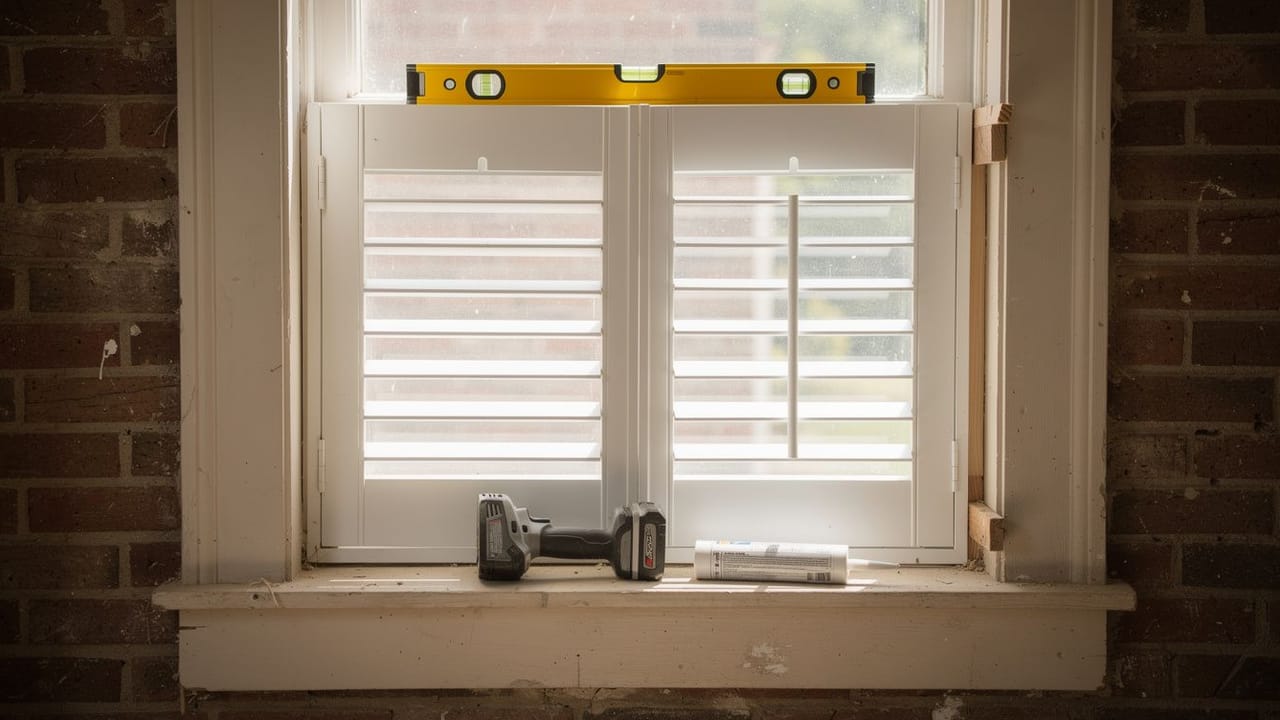
The Palm Beach tool list is short and tells you what the job involves: a level, shim material, and finishing supplies such as caulk and sealant. Those three do most of the work of making a square product sit in an imperfect hole.
Racking the panels level once the frame is up
With the frame fixed, the panels go on their hinges, and the next job is getting them to hang level with one another and meet without a gap that widens toward the top or bottom. Hunter Douglas describes this for its framed Palm Beach panels as racking: the installer retracts the panel catches so the shutter can be pushed out of square slightly within the frame until the panels hang level, then sets screws in the top and bottom holes first and fills in the rest, checking after every screw that the panels have stayed aligned and re-adjusting if they have not.
Unframed hinged panels, which mount straight to the jamb with no frame around them, are squared differently. The same instructions have the installer loosen the hinge screws and slide the hinge, or put thin hinge shims between the hinge and the hang strip, until the panel is square and aligned to the opening, then tighten everything again. It works, but there is less to absorb the irregularity, which is one reason we use a frame on most openings.
A properly hung set shows it in the louvers. With the panels closed, each louver should line up with its neighbor across the meeting stiles, and the divider rails, where there are any, should form one straight line. If the louvers step up or down at the center, the panels are not level with each other, and that is fixed at the frame or the hinges, not left for the household to live with.
How out of square is too far for an inside mount
Whether an opening can take an inside mount is decided at the measure, before anything is ordered. As our measuring post explains for blinds, width is measured at the top, middle and bottom and height at the left, center and right. For shutters the diagonals are measured too, corner to corner both ways. If the two diagonals are equal, the opening is square. If they differ, it is not, and the size of the difference decides what happens next.
For its own Palm Beach shutters, the Hunter Douglas reference guide sets the line at a 1/2 inch difference between the diagonals: past that, it says to reduce the ordered size accordingly or consider an outside mount. That figure belongs to that product and that maker’s ordering rules. Other lines and other manufacturers draw the line in their own place, and we follow the published guidance for whichever shutter is being ordered.
The same guide notes that a frame helps compensate for an out-of-square opening, and that an outside-mount frame overlaps the face of the wall or trim, by 5/8 inch up to 2 3/16 inches depending on the frame style in that line. That overlap is what lets an outside mount cover a crooked opening: the frame sits square on a flat surface and the irregular edge is hidden behind it. In older houses around Nashville, where plaster walls and original casings have moved over the years, that is often the cleaner answer than forcing an inside mount into an opening that has drifted.
- Diagonals equal: the opening is square and an inside mount fits as measured
- A small difference: the frame is shimmed and the gap at the jamb is finished
- A larger difference: the order is reduced or the shutter moves to an outside mount, by the maker’s own rule
Caulk, shims and why wood keeps moving
Once the frame is square in a slightly irregular opening, there will be a gap between frame and jamb that is not the same all the way down. The shims stay where they hold the frame, and the Palm Beach instructions close the job with caulking and other finish work. A neat bead in a color that matches the frame or the trim makes the shutter read as part of the window instead of something set into it.
The other reason to leave a frame square and properly fastened rather than forced is that the house around it does not stand still. The USDA Forest Products Laboratory’s Wood Handbook, chapter 4, explains that wood takes on and gives up moisture, swelling as it gains it and shrinking as it loses it, and that this movement can cause warping, splitting and gaps where wood sees large swings in moisture. It moves most across its width, roughly half as much in thickness, and barely at all along its length.
Middle Tennessee gives indoor wood both ends of that: humid summers and dry, heated air in winter. Window jambs, casings and hardwood shutter frames all move a little with the seasons. A frame set with even shims and snug screws moves with the opening; one wedged tight against a swollen jamb in August can bind or open a gap by January. Composite and vinyl shutters do not take on water the way wood does, but the trim they are fastened to still moves, and the installation has to allow for that either way.
Before an installer leaves, every panel should swing freely without rubbing the frame, close flat, latch, and line up with its neighbor. The louvers should hold their position when tilted. The caulk line should be continuous. If any of that is not right, it is fixed that day. To have your windows measured and the mount decided at the opening, ask us for an estimate.
Sources
- Hunter Douglas Architectural, Palm Beach Polysatin Shutters: Installation, Operation, Care — For its Palm Beach shutters: tools including level, shims and caulk; centering and shimming an inside-mount frame; the 1/4 inch outside-mount reveal; racking framed panels; squaring unframed panels at the hinges
- Hunter Douglas Architectural, Palm Beach Polysatin Shutters Reference Guide (May 2025) — For its Palm Beach shutters: measuring width, height and diagonals; the 1/2 inch diagonal difference past which it reduces the size or suggests an outside mount; frames compensating for out-of-square openings and outside-mount overlap
- USDA Forest Products Laboratory, Wood Handbook (FPL-GTR-282), Chapter 4: Moisture Relations and Physical Properties of Wood — Wood swells and shrinks with moisture, most across its width, and the warping and gaps that movement can cause