
· by Michael Blair, Nashville's Shutters and Blinds
Blackout fabric blocks light through the material, and Hunter Douglas’s light control page describes opaque fabrics as almost completely blocking it. The fabric does nothing about the gaps at the sides, top and bottom, which is where much of the light in a supposedly dark room comes from.
Where does light get past a blackout shade?
When we measure for an inside mount, we leave a small clearance down each side so the shade can roll or lift without rubbing the frame, and light comes through that gap. Whether a window can take an inside mount at all is its own question, covered in our post on inside or outside mount.
Side channels that the shade runs in are what close those edges. On the Hunter Douglas LightLock system, the U-shaped side channels fit into the window and absorb light so it does not reach the room. The manufacturer talks about its own range in the same terms: its room darkening page lists minimal light gaps among the features of its Designer Roller Shades.
What actually works
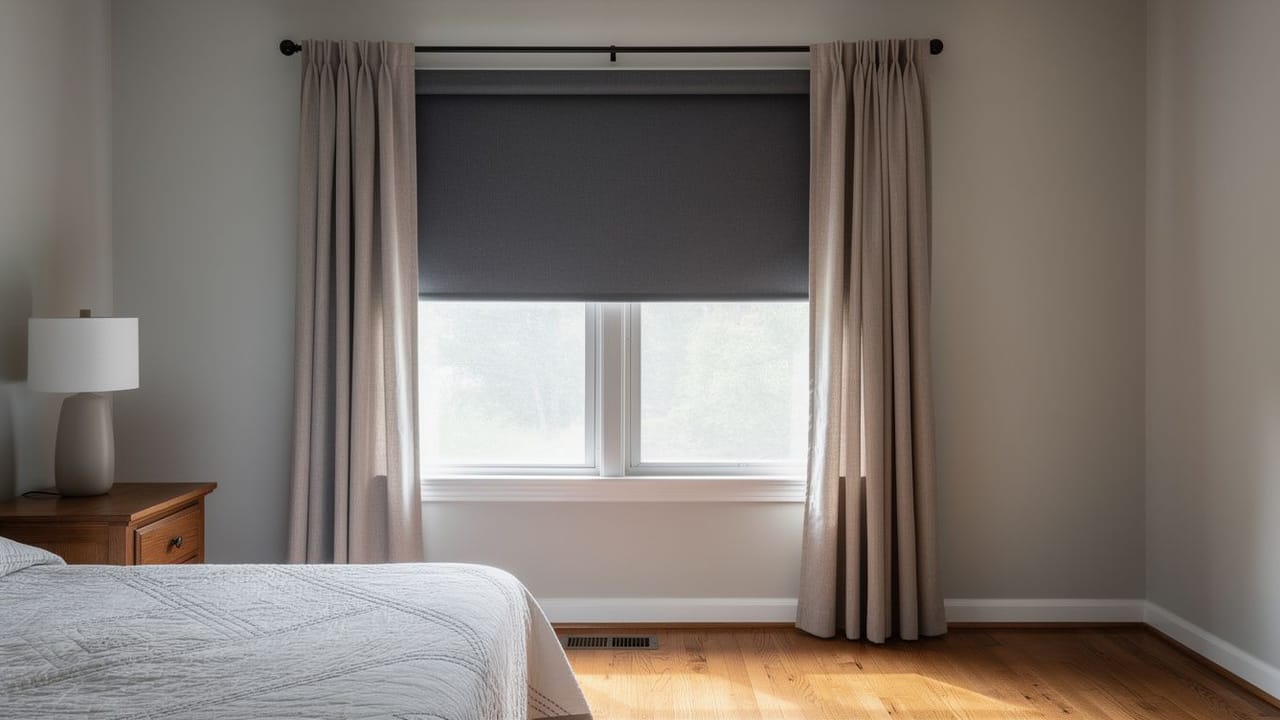
For a bedroom we start with a blackout roller or cellular shade in side channels, both of which are on our shades page. Where channels will not fit the window, we mount the shade outside the opening and size it to run past the frame on each side. Lined drapery over the shade covers what is left, and Hunter Douglas says the same, that adding drapery or side panels can help cover light gaps at the window. We hang it on a rod that returns to the wall, so the edge of the panel meets the wall instead of standing off it.
That layering is how we approach a bedroom that has to be dark, rather than asking one product to do everything.
- Side channels stop light at the edges of the shade
- Outside mount past the frame where channels will not fit
- Lined drapery on a return rod over the shade
- Cover the gap above the headrail
- Check the room itself for standby lights
The top gap
Light above the headrail is easy to miss. We close it with a valance or a fascia, or avoid it by mounting outside the opening so the shade sits above the window entirely.
So when we check a bedroom that is still too bright, we look up at the headrail as well as along the sides.
What light comes from inside the room?
Standby lights on electronics, a smoke alarm indicator and light under the door are all worth checking in a room that is otherwise dark. The NHLBI’s page on healthy sleep habits advises keeping the bedroom quiet, cool and dark, and says a dim night light is fine if needed.
For a sense of scale, a 2022 study in PNAS had healthy adults sleep one night in a lab under moderate light of 100 lux; compared with a dim room under 3 lux, their heart rate ran higher through the night and their insulin resistance was higher the next morning. That study measured room light, not a standby glow, so before deciding a shade has failed, we close everything, turn the lights off and look for where the light is actually coming from. If you would like us to do that in your bedroom, ask us for a free estimate.
Sources
- Hunter Douglas, Light Control & Privacy — Opaque fabrics almost completely block light; LightLock U-shaped side channels absorb light at the edges; drapery or side panels help cover light gaps
- Hunter Douglas, Room Darkening window treatments — Designer Roller Shades listed with minimal light gaps
- NIH National Heart, Lung, and Blood Institute, Healthy Sleep Habits (2022) — Keep the bedroom quiet, cool and dark; a dim night light is fine
- Mason IC et al., Light exposure during sleep impairs cardiometabolic function, PNAS (2022) — One night at 100 lux versus under 3 lux raised nighttime heart rate and next-morning insulin resistance in healthy adults in a lab
FAQ
Getting a Bedroom Genuinely Dark — questions
Why is my blackout blind still letting light in?
If the fabric is opaque, the light is usually coming around the edges. An inside-mounted shade is fitted with a little clearance at each side so it can move freely, and light comes through that gap. Side channels that the shade runs in are what stop light at the edges.
Are blackout curtains better than blinds?
Each has a weak spot. A shade sits in or over the opening and can leak at its edges, while drapery can cover the gaps around a shade, and on a rod that returns to the wall its side edge meets the wall. Layering both, a blackout shade with side channels plus lined drapery over it, covers more of the gaps than either alone.
How do I stop light coming over the top of a blind?
A fascia or valance above the headrail closes that gap, or the shade can be mounted outside the opening so it sits above the window entirely. It is easy to overlook once the sides have been dealt with, so it is worth checking with the room dark.
Which blinds are best for blackout?
A roller or cellular shade in opaque fabric that runs in side channels, because the channels stop the light that leaks past the edges. Where channels will not fit, an outside mount that runs past the frame does a similar job. Lined drapery on a return rod over the shade covers what is left.