
· by Michael Blair, Nashville's Shutters and Blinds
Plantation shutters cost more than most blinds, and they are usually the most expensive thing we put on a window. Our shutters and blinds guide sets out what drives the price of each treatment here. What the extra buys is a piece of fitted joinery with no fabric in it, something you clean with a duster, and whether that is worth it comes down to the room, the window and how long you mean to live in the house.
What you get
A shutter is a frame fixed to the window with hinged panels of louvers hung from it. The louvers tilt with a rod on the face of the panel or a hidden linkage at the back, so the shutters we fit have no operating cord to hang down. Blinds are different: since May 30, 2023, the federal safety standard for operating cords on custom window coverings has governed the cords on custom blinds, shades and shadings, meaning the part of the cord you handle to lift, lower or tilt them. Our post on cord safety covers what that means for the blinds already in your house.
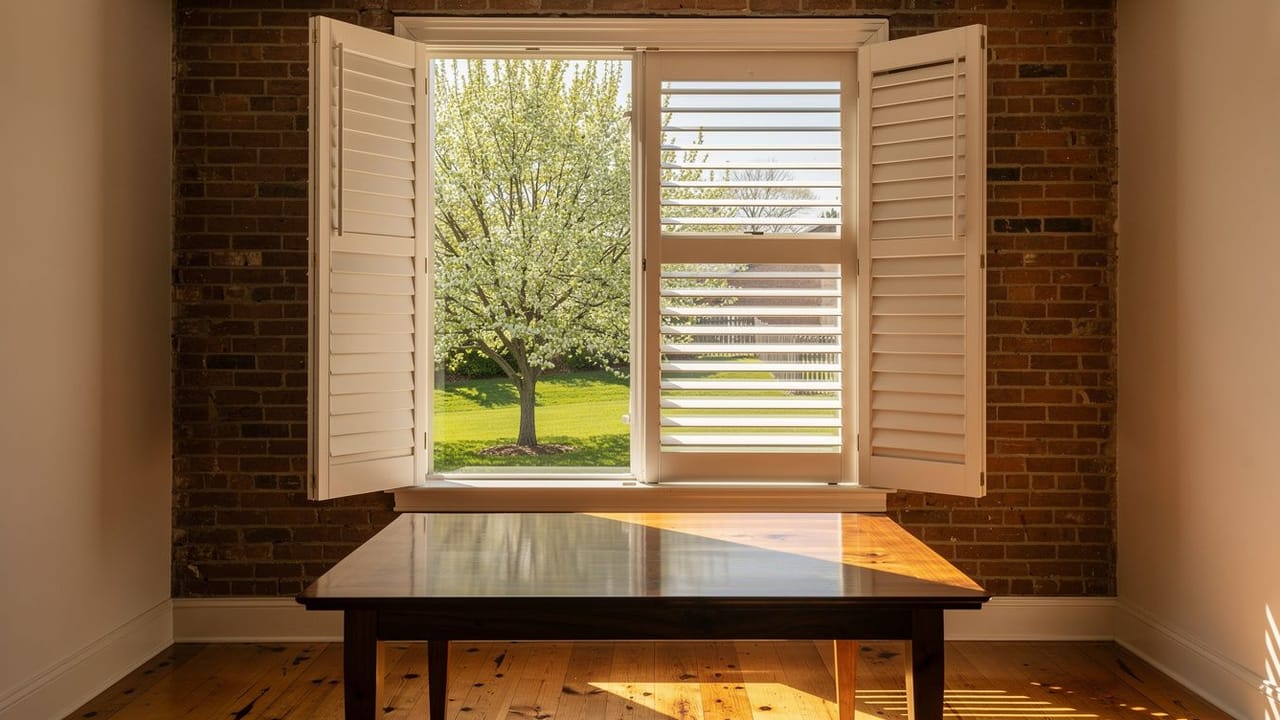
We build the plantation shutters we fit to the opening they go in, on a frame shimmed true to it, so a closed panel shuts against that frame instead of hanging in front of the glass. How much any covering does for a hot west window is a separate question, and our post on window treatments for heat takes it up.
Materials
Hardwood is the traditional choice and the one humidity affects most. The USDA Forest Products Laboratory’s Wood Handbook explains that wood takes on moisture from the air around it, swells as it gains moisture and shrinks as it loses it, and that this movement can warp, check or split it. The same chapter says dimensional stability has to be considered wherever a wood product will see large swings in moisture, and a bathroom window, steamed by every shower and dry in between, is that kind of place.
So we keep hardwood to dry, conditioned rooms and fit composite or vinyl in bathrooms, kitchens and laundry rooms. Weight, stiffness and the widest panel a line allows differ from one manufacturer to the next, and we check them for the product we are quoting. Our post on louvers, frames and materials goes through the choice room by room.
- Hardwood: the traditional choice, which many people prefer to look at, but it moves with humidity
- Composite or vinyl: what we fit in bathrooms, kitchens and laundry rooms
- Louver width: sized to the window, and we show you the difference before ordering
- At sale: shutters fixed to the frame typically stay, but the contract decides
- Measuring: each set is built to one opening, so we measure every window on site
Do shutters stay with the house when it sells?
Shutters mounted to the window frame typically stay with the house when it sells, but that is for the sales contract to settle, not a rule you can rely on. If you want them to stay, or to come with you, put it in writing.
Whether a buyer pays more because of them is harder to say, and we would not promise it. They may help a house’s appeal when it is shown. The firmer case is a house you plan to live in for years, which is also why they make less sense in a rental, where a faux wood blind does the job for less.
When are plantation shutters the wrong answer?
Very wide openings, where several panels have to fold back against the side of the window and stay there. Windows you want completely clear, because the frame and the folded panels take up part of the opening even when they are open.
And any house where the budget would go further covering every window properly than a few of them expensively. If you cannot tell which side of that line a room falls on, book a free estimate and we will measure it and price both ways.
Sources
- USDA Forest Service, Forest Products Laboratory, Wood Handbook (FPL-GTR-282), ch. 4, Moisture Relations and Physical Properties of Wood — Wood is hygroscopic, swells as it gains moisture and shrinks as it loses it, which can warp, check or split it; dimensional stability matters where moisture fluctuates
- eCFR, 16 CFR Part 1260, Safety Standard for Operating Cords on Custom Window Coverings — Effective May 30, 2023; covers operating cords on custom blinds, shades and shadings; defines the operating cord as the part handled to lift, lower or tilt
FAQ
Are Plantation Shutters Worth the Cost — questions
Do plantation shutters add value to a home?
Shutters fixed to the window frame typically stay with the house when it sells, though the sales contract is what settles it. They may help a house show well, but we would not count on a buyer paying back what they cost. The stronger case for them is a house you mean to live in for years.
Wood or composite shutters in Nashville?
Hardwood is the traditional choice and the one many people prefer to look at, but wood swells as it takes on moisture from the air and shrinks as it dries, and that movement can warp it. We fit hardwood in dry, conditioned rooms and composite or vinyl in bathrooms, kitchens and laundry rooms, so a house can easily end up with both.
Are shutters good for very wide windows?
Often not. The panels have to fold back somewhere, and on a wide opening that means several of them stacked against the side of the window, taking up part of the view. We usually suggest a different treatment for a very wide window, or a shutter divided into sections by a post, and we settle it at the window once it is measured.
Are plantation shutters expensive?
Yes, compared with most blinds, and they are usually the most expensive covering we fit. Each set is built to one opening and measured on site, so the price follows the window. Where the budget would go further covering every window well than a few windows in shutters, we price both ways at the estimate.