
· by Michael Blair, Nashville's Shutters and Blinds
In a Middle Tennessee house the windows are the part of the wall with the least insulation, and on a cold night the glass is the coldest surface in the room. Warm room air meets it, cools, drops to the floor and rolls across the room as a draft that has nothing to do with a leak. Blinds and shutters chosen for summer glare often do very little about that. The coverings that help in winter are the ones that trap a layer of still air against the window and close it off at the edges.
What actually slows heat loss at a window
Three things matter: a layer of still air, a material that does not conduct heat well, and a fit that keeps room air from circulating behind the covering. A slatted blind has none of them. Even closed, the slats leave gaps, and room air runs down behind them, touches the glass and falls out the bottom.
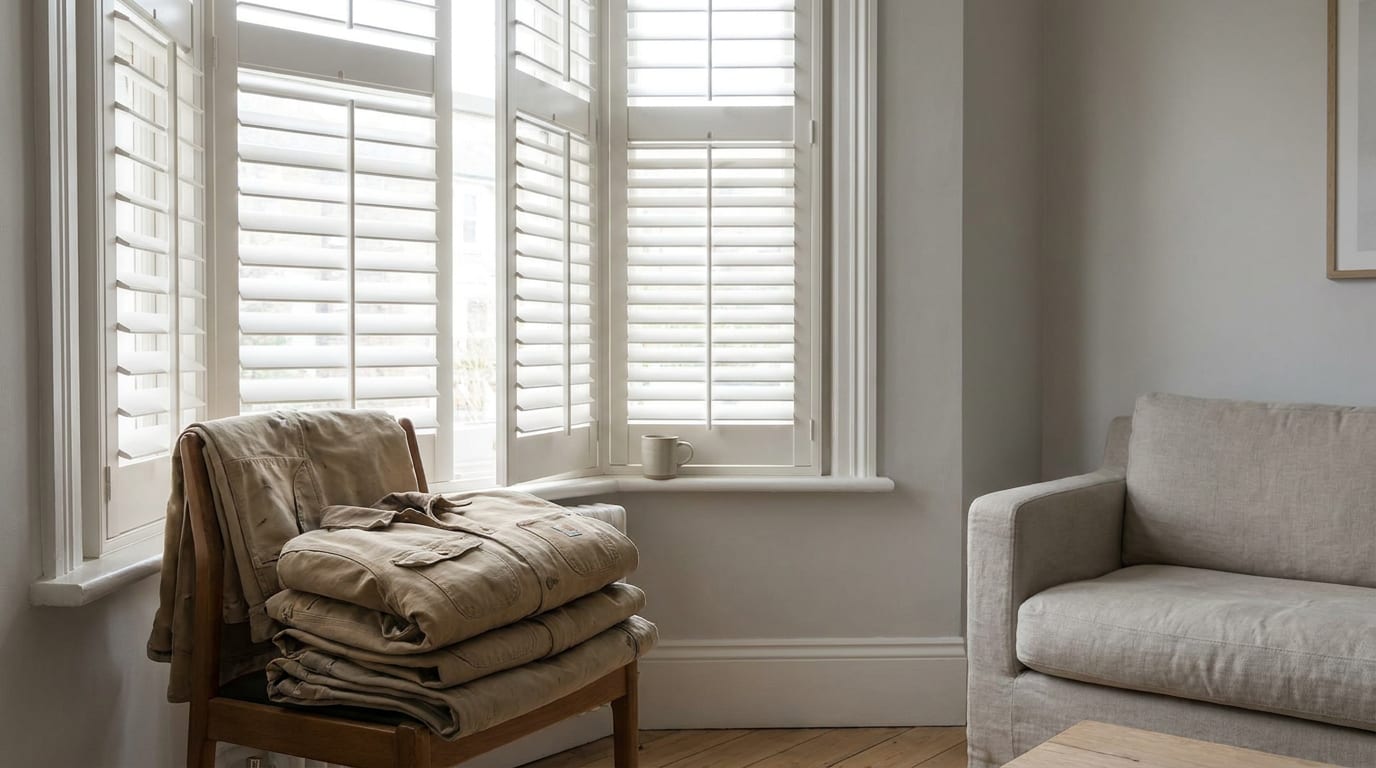
Cellular shades do best because the honeycomb holds air in pockets, and double-cell versions hold more. Mounted inside the frame with a close fit, and ideally with side channels, they stop most of that loop. Plantation shutters come next; the panels are solid wood or composite with little gap once the louvers close, and a shutter fitted tight to its frame does a creditable job. Lined drapes that run past the frame on both sides and touch the sill or floor are the third option, and the cheapest.
Using them through the day
On a clear winter day a south-facing window takes in real warmth from the low sun, and a covering left closed throws that away. Open the south and west windows once the sun is on them, and close everything at dusk, before the glass has cooled the room. North windows can stay closed most of the day in the coldest weeks without losing anything.
Motorized shades make this routine easy, because a schedule does it every day without anyone thinking about it. For people who travel, or who leave for work before sunrise, that is often where motorization pays for itself in a way a summer glare problem never did.
Condensation behind a tight covering
A covering that seals well against the glass also keeps the glass colder, because the warm room air no longer reaches it. On older single-pane windows, common in East Nashville bungalows and Sylvan Park cottages, that can bring the glass below the dew point of the air trapped behind the shade, and water collects on the pane and the sill by morning.
A little of this on the coldest mornings is harmless if the shade is raised to let it dry. Every morning, on a wood sill that is starting to darken, it is rotting the window. The cure is lower indoor humidity, a storm window over the old sash, or a covering that fits a little less tightly so some room air keeps the glass warm.
- Raise tight shades during the day so glass and sill dry out
- Watch wood sills on single-pane windows for dark staining
- Run bath and kitchen fans; winter humidity comes from inside
- Consider a storm window before a tighter shade on old glass
Choosing for both seasons
A Nashville house needs coverings that work for a long cooling season and a short but real heating one. A light-colored exterior face on a cellular shade reflects summer sun from the outside, and the same cells hold heat in winter, which is why they are the usual answer on a room that is uncomfortable year-round.
Where shutters are already installed and a room is still cold, adding a lined drape on a rod above them is often better value than replacing them. Where the windows themselves are failing, with loose sash and gaps you can feel, no covering will fix it, and the money belongs with the windows first.