
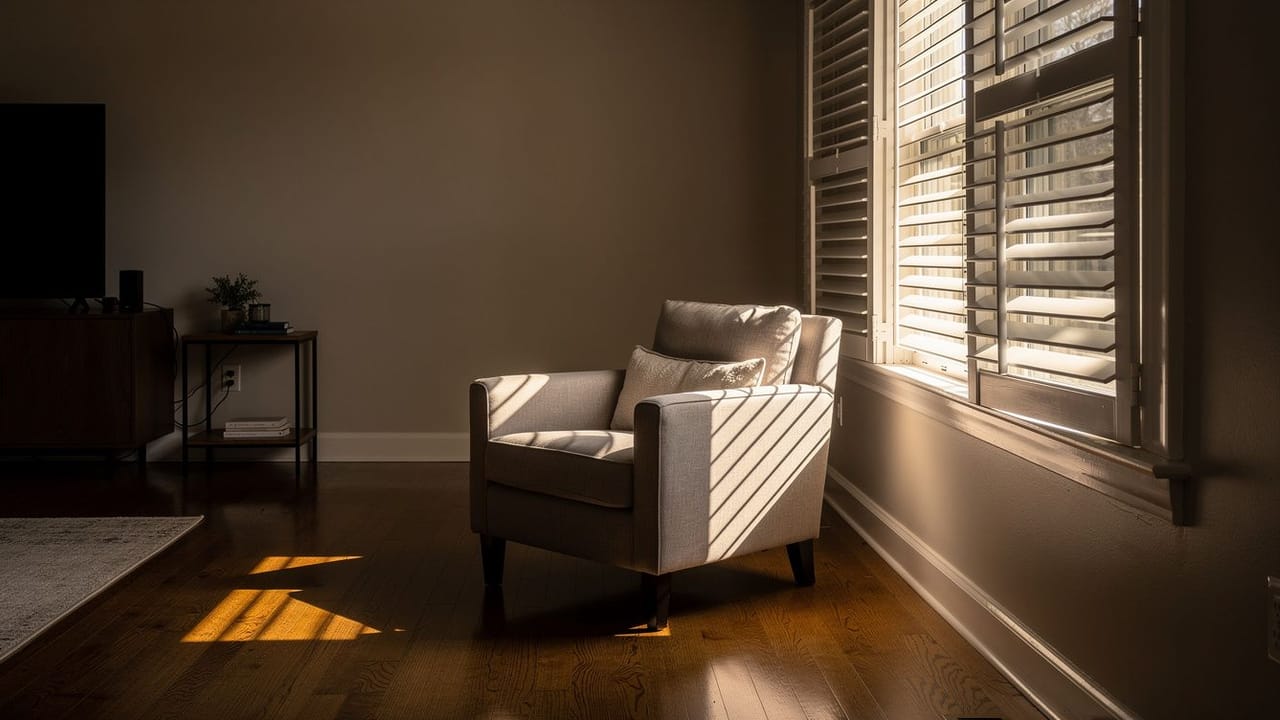
· by Michael Blair, Nashville's Shutters and Blinds
A rug that is two colors, a sofa arm paler than the cushion, a floor with a lighter rectangle where a chair used to sit: sun fading shows up slowly and then all at once. The best research on it comes from people protecting historic rooms and museum furniture, and it is more useful to a homeowner than most product claims. Here is what fades things, what closing blinds, shades and shutters actually does, where UV film fits, and how we would set up a room that takes the afternoon sun.
What fades furniture and floors near a window?
Furniture and floors near a window fade from both ultraviolet and visible light, not from UV alone. A National Park Service technical note, Reducing Visible and Ultraviolet Light Damage to Interior Wood Finishes, reports a ten-year fade test of wood stains that began in 1978. A UV filter cut the ultraviolet reaching the samples from roughly 450 microwatts per lumen to about 50, yet it made only a negligible difference to how well the aniline dye stains held their color. Visible light through the protected glass still did significant damage to certain stains.
The same note shows a chair seat that faded in eleven years under unfiltered daylight. A University of Florida extension fact sheet from 2002, Environmental and Chemical Effects on Home Furnishings, makes the household version of the point: sunlight fades textile furnishings, and wood furniture changes color in the sun. Both sources are older and one comes from museum work, but the physics of light on a finish has not changed.
Do closed blinds and shutters actually protect a room?
Closed blinds and shutters protect what is behind them for as long as they are closed and the sun is on that window, and no longer. The Park Service note points out that curtains, Venetian blinds and interior and exterior shutters were long used both to keep rooms cool and to slow fading. Its recommendations for historic interiors are about use, not just ownership: run roller shades down whenever direct sun comes in or the room is empty, work the shutters and blinds through the day, and close draperies in direct sun.
The University of Florida sheet says much the same for a home. Keep draperies, blinds or shades drawn in the hours of strongest sun, and if that is not practical, rotate furniture in and out of the sunny spots every month or so.
Neither source gives a percentage for how much a covering reduces fading, and the figures that circulate in product marketing do not trace back to any test we could find. What the sources do support is simpler: a covering only helps if it is closed when the sun is on the glass. With shutters, that means louvers turned shut, not just panels closed.
Is UV window film enough to stop fading on its own?
UV window film is not enough on its own, because it deals with ultraviolet and leaves visible light, which the Park Service test showed still fades some finishes. The Service’s guide for museums, Choosing UV-Filtering Window Films from August 2004, sets an acceptable level for collections at 50 microwatts per lumen and notes that most solar film literature claims 98 percent of UV filtered, then asks the fair question of 98 percent of what. Its answer is that most films reach that figure only between about 325 and 380 nanometers, while the ultraviolet that matters behind window glass runs to about 400.
Film can still be worth having on a window that cannot be covered during the day. It just does not replace closing something over the glass when the sun is direct.
How should a west or south window be covered against fading?
A west or south window is best covered against fading by something that closes fully, is actually closed during the hours of direct sun, and is paired with moving the most light-sensitive pieces out of the path the sun takes across the floor. The Park Service makes that last point too: keep particularly sensitive furnishings away from direct window light.
In practice we would put plantation shutters with louvers that close tight, or shades in a room-darkening or light-filtering fabric, on the windows that take the afternoon sun. Lined drapery is another option; the Florida sheet notes that a lining, possibly acrylic, helps protect the drapery fabric itself from fading. Where nobody is home in the afternoon to close anything, motorized shades can be scheduled to do it. If the same window also makes the room too hot, our post on window treatments for Nashville heat covers that side. To talk through a room that takes the sun, tell us which way the windows face.
Sources
- National Park Service, Preservation Tech Note, Museum Collections No. 2: Reducing Visible and Ultraviolet Light Damage to Interior Wood Finishes (undated; fade test begun 1978) — Ten-year fade test: UV filter cut UV from about 450 to about 50 microwatts per lumen with negligible effect on aniline dye stains; visible light still damaging; blinds, shutters and curtains historically used against fading; close shades and draperies in direct sun; move sensitive furnishings; chair seat faded in eleven years
- National Park Service, Conserve O Gram 3/10: Choosing UV-Filtering Window Films (August 2004) — 50 microwatts per lumen benchmark; 98 percent UV claims refer to roughly 325 to 380 nm; film does not address visible light
- University of Florida IFAS Extension, FCS 3156: Environmental and Chemical Effects on Home Furnishings (August 2002, archival copy) — Sunlight fades textile furnishings and changes the color of wood; keep coverings drawn in intense sun or rotate furniture monthly; a lining helps protect drapery fabric
FAQ
Do Blinds and Shutters Stop Furniture Fading? — questions
How do I protect furniture from sun damage?
Close blinds, shades, shutters or draperies during the hours direct sun reaches the window, and move the most sensitive pieces out of the sun’s path. The University of Florida extension suggests rotating furniture in and out of sunny spots every month or so if covering the window is not practical. UV film helps, but it does not stop visible light.
Does visible light fade furniture as well as UV?
Yes. In a National Park Service fade test of wood stains, a filter cut ultraviolet from about 450 to about 50 microwatts per lumen, yet made only a negligible difference to how aniline dye stains held up. Visible light through the protected glass still caused significant damage to some stains, which is why filtering UV alone is not enough.
Do plantation shutters block UV rays?
We found no test figure for how much ultraviolet plantation shutters block, so we won’t quote one. What we can say is that shutters with the louvers closed keep direct sun off whatever is behind them, and that is when they protect against fading. With louvers open, light reaches the room and so does the fading.
How do I stop sunlight fading my hardwood floors?
Keep direct sun off the floor during the hours it reaches the window, with shades, blinds or shutters that close fully, and move rugs occasionally so one patch is not shaded for years while the rest fades. The University of Florida extension notes that wood changes color in sunlight, and visible light, not only UV, does part of that.
Should I close blinds during the day to protect furniture?
Close them during the hours direct sun reaches that window, and when the room is not in use. That is the National Park Service’s advice for historic interiors and the University of Florida extension’s advice for homes. Blinds left open in direct sun do nothing for fading, however good the product is.