
· by Michael Blair, Nashville's Shutters and Blinds
A French door is mostly glass, and the glass reaches almost to the handle. That is the whole difficulty with putting shutters on one. A window shutter has a quiet opening to sit in; a door shutter has to share a few inches of trim with a knob, a lever or a deadbolt, open and close every day without fouling it, and keep its louvers clear of the glass when they tilt.
The shutter makers have worked this out in their ordering guides, and the choices are fewer than they first look. This post goes through how a door shutter is mounted, the three ways it gets around the handle, how much flat room each one needs, and the depth the louvers ask for. It is the hinged-door companion to our post on sliding glass doors, where the panels run on a track instead.
How is a door shutter different from a window shutter?
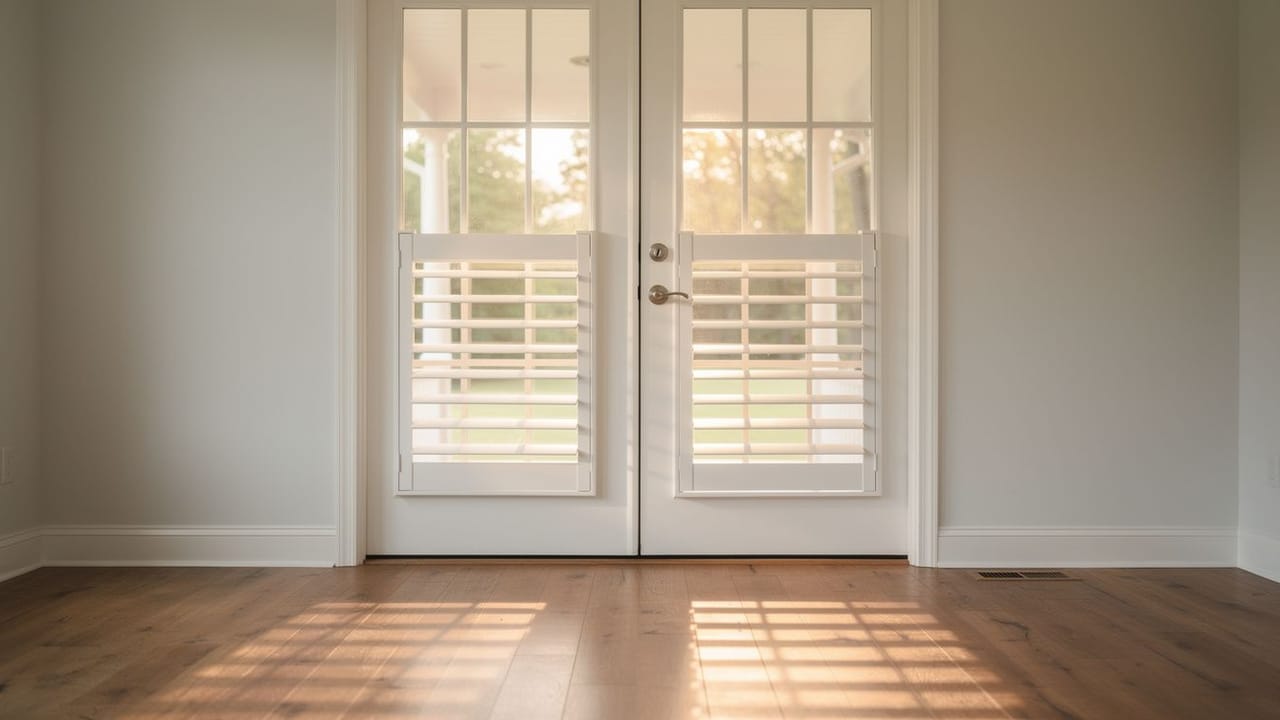
A door shutter is a single panel fixed to the door itself, not to the wall around it, so it swings with the door. Levolor’s Premier Hardwood Shutters reference guide (February 2025) says French door shutters are always ordered as outside mount, as one panel hinged on the same side as the door. On a pair of doors, that means one panel per door, each opening the way its own door does.
The opening is measured differently too. Sunland Shutters’ measuring instructions (revised February 2026) count the trim strips that hold the glass in as part of the opening, have you measure width and height in three places and take the largest, and call for a four-sided frame. A window inside a deep jamb can often take an inside mount; a door gives the frame nowhere to hide, which is why the frame choice matters more here than it does on a window shutter.
Pairs raise one more point. Often only one door of a pair needs a cut-out for its handle. Levolor has a separate order code for the other door, a companion panel built without a cut-out, so that both panels come out the same height with matching louver counts, rail sizes and divider rail positions. If the two are ordered as unrelated panels, they can come back looking like different shutters.
How do shutters fit around a French door handle?
There are three ways, and the handle chooses between them. The Levolor guide lists a four-sided hang strip, an L-frame, or a cut-out panel, and Hunter Douglas’s Heritance and NewStyle installation guide, a 2016 document written for its certified installers, shows the same three. Here is what each one is for.
- Four-sided hang strip: a thin mitered frame that the closed panel hides, so only the shutter shows from the room. Levolor suggests it where the door has a small handle, and notes the narrow strip suits the tight clearances typical of French doors.
- L-frame: a visible frame for people who want the framed look, set on the flat trim between the glass and the handle. It only works if that strip of trim is wide enough, which is the next section.
- Curved cut-out: a notch in the panel’s edge that the handle passes through, with a 3/8 inch back plate behind it that sits against the door. Levolor makes it 3 1/2 inches for most levers and 5 inches for longer levers and deadbolts.
- Rectangular cut-out: the same idea at a custom size, 2 to 7 inches wide in Levolor’s guide, for hardware that does not fit a curve.
How much flat space around a door handle do shutters need?
Levolor recommends at least 1/2 inch of flat surface beside the handle to fasten the frame to, and ideally 1 3/8 inches. At 1 3/8, the whole base of the frame sits flat with room for a 1/4 inch reveal, and the frame cannot be seen from the far side of the door. Below 1/2 inch, Levolor’s answer is a cut-out with a 1 1/8 inch offset, which moves the flange out by the width of the frame base for doors where the handle sits close to the glass.
Sunland sets its own figures. Its French door pages ask for 1 1/2 inches between the opening and the base of the handle for an L-frame, and at least 2 inches for its Deco Sill frame, and say a cut-out is the best fix when the room is not there, with the plate recessed or raised to clear the trim. The two makers do not agree to the eighth of an inch, so we measure to the rules of the shutter being ordered, not a general number.
For a lever, Levolor lists a few things to weigh before cutting the panel at all: turning the handle 90 degrees, swapping it for a knob or an egg-shaped handle, or fitting a handle extension so it clears the shutter. If the cut-out is the answer, its template is lined up on the base of the handle, and the lever has to turn fully inside the cut-out. We check that turn on site with the template, because a lever that catches the edge of a notch is caught every time the door is used.
Louver size, tilt rods and the glass
A louver has to swing through its full tilt without touching the door glass or the trim around it, and bigger louvers need more room to do it. Sunland says a French door generally needs a build-out to give the louvers that clearance, and that its hidden tilt rod adds another 1/2 inch to the louver clearance.
Levolor’s table shows how tight it gets: its 2 3/8 inch L-frame takes 2 1/2 inch louvers with a front tilt rod only, takes 3 1/2 inch louvers with either a front or concealed rod, and is not offered with 4 1/2 inch louvers at all. Its 2 7/8 inch L-frame, half an inch deeper at the base, takes all three louver sizes with either rod.
So a homeowner who wants wide louvers and no visible tilt rod on a door is asking for the deepest frame there is, and on some doors there will not be room for it. We would rather say so before ordering than discover it when a louver hits the glass. Levolor’s guide repeats the same caution for every French door frame: always check for clearance and anything that could get in the louvers’ way.
How are shutters fastened to a French door without breaking the glass?
Shutters on a French door are fastened differently from those on a window, with the screws angled so the glass does not break. Levolor’s installation instructions for its poly Shutters Collection say to angle the screws so the glass does not break and to keep them clear of the handle hardware and lock, and the 2016 Hunter Douglas guide gives the same warning. That guide also calls for at least two magnets on every French door installation to hold the panel shut against the frame.
If you have a French door in Franklin or anywhere else we work, send us a photo of the handle side and the door count, and we will measure the flat trim, check the lever turn and tell you which of the three frames the door can take.
Sources
- Levolor, Premier Hardwood Shutters reference guide (24-0025-109, February 2025) — French door shutters: outside mount, single panel hinged on the door’s side; hang strip, L-frame or cut-out; 3 1/2 and 5 inch curved and custom rectangular cut-outs; 1/2 inch minimum and 1 3/8 inch ideal flat mounting surface; 1 1/8 inch offset; lever alternatives; front and concealed tilt by frame and louver size; companion panel without cut-out
- Sunland Shutters, Measuring Instructions (revised February 2026), French door pages — Glass trim strips count as the opening; measure three places; four-sided frame; 1 1/2 inch mounting surface for L-frame and 2 inch for Deco Sill; cut-out where space is short; build-out generally required; hidden tilt adds 1/2 inch to louver clearance
- Levolor, Shutters Collection (poly) installation instructions (24-0025-120, February 2025) — French door frames and cut-outs; cut-out placed to fit around the hardware; angle the screws to avoid breaking the glass and keep them clear of the handle and lock
- Hunter Douglas, Heritance Hardwood and NewStyle Hybrid Shutters: Installation, Operation, Care (2016) — The 2016 document’s French door section: cut-out, L-frame and four-sided hang strip versions; angled screws to protect the glass; at least two magnets on every French door installation
FAQ
Plantation Shutters on a French Door, Around the Handle — questions
Can you put plantation shutters on French doors?
Yes. Each door gets one shutter panel mounted on the door itself, outside the glass, and hinged on the same side as the door so it swings with it. The frame is a hidden four-sided hang strip, a visible L-frame, or a panel with a cut-out for the handle, chosen by how much room the handle leaves.
What is a cut-out on a door shutter?
It is a notch in the edge of the shutter panel that the door handle passes through, backed by a thin plate that sits against the door. Levolor makes curved cut-outs at 3 1/2 inches for most levers and 5 inches for longer levers and deadbolts, plus a rectangular cut-out in custom sizes.
Will shutters on a door stop the door from opening?
They should not, because the frame is fastened to the door and the panel moves with it. What can go wrong is the handle: a lever that hits the panel or the edge of a cut-out. That is why the cut-out template is lined up on the handle base and the lever is turned through its full travel before ordering.
Does a hidden tilt rod on shutters need extra depth?
Yes, by one maker’s rule. Sunland adds 1/2 inch to the louver clearance for its hidden tilt rod. Levolor does not offer a concealed rod on every frame and louver combination; its shallower 2 3/8 inch door L-frame is not offered with 4 1/2 inch louvers at all, with either rod.
Can you put shutters on a door with a deadbolt?
Usually, with a larger cut-out. Levolor’s 5 inch curved cut-out is meant for longer levers and deadbolts, and its rectangular cut-out can be ordered at a custom size up to 7 inches wide. Sunland uses a rectangular cut-out for doors that have both a handle and a deadbolt lock.